Water chemistry log
Pool chemical tracking software, built into the visit screen
Water chemistry is not a separate app or a spreadsheet to fill in later. Eight test inputs sit on the visit screen, so the reading is captured where the tech is standing and lands on the pool record and the customer’s report on its own. What goes in the water stays your call.
3-month free trial · every feature included · month-to-month
On the visit screen
Log the reading before you leave the pool
Eight test inputs, entered at the stop. It keeps working with no signal and syncs when the phone finds service, so nothing waits on a clipboard to be typed up back at the truck.
Visit screen · sample
Sample readings for a salt plaster pool, shown to illustrate the visit screen. Not a live feed.
Eight test inputs
Free and total chlorine, pH, total alkalinity, cyanuric acid, calcium hardness, salt, and water temperature, captured at the stop and saved offline when the backyard has no signal.
Works with any kit
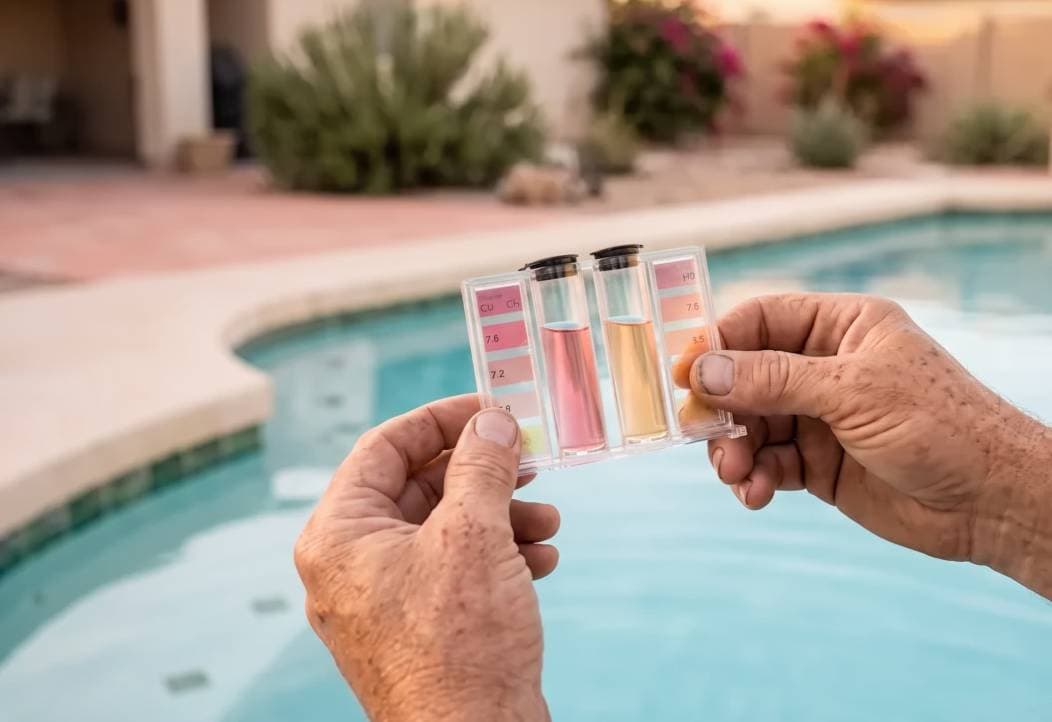
Strips, a comparator block, a digital meter or a drop kit: whatever your techs already carry, the reading goes in the same eight fields. Nothing to buy and nothing to standardise across a crew.
On the pool record
Every reading stays on that pool's history, so a year of results sits in one place instead of on a clipboard. When a customer asks what the water has been doing, the answer is on the screen.
On the customer report
The readings you logged go out on the branded visit report to the pool owner, under your name, without anyone retyping them into an email.
Built for pools, not bolted on
Real pool chemistry, grounded in recognized standards
PoolBeacon records what your tech measured. It does not tell them what to add. That line is deliberate: the reading depends on which kit was used and how it was run, and the decision depends on the pool, the chemicals on the truck, and the label on the jug. Those are yours to weigh, and the software does not pretend otherwise.
What it does own is the record. Readings captured at the stop, held against the pool, and sent to the owner on your branded report, with an offline mode that keeps working when the backyard has no signal. That is the part a generic field-service tool turns into a custom text field and an email you write yourself.
How to use these tools
PoolBeacon is a record of the readings your technician took. It does not interpret them, recommend a dose, calculate a saturation index, or tell you whether the water is safe. Every chemical decision, including what to add and how much, belongs to the qualified professional on site, working from their own test kit, the manufacturer's label, and their local health code. Handle and store chemicals safely, and never mix them.
Pool chemistry questions, answered
- Does PoolBeacon calculate the saturation index?
- No. PoolBeacon records the readings your technician took and does not compute a saturation index, an LSI, or a CSI from them. Reading the water is the professional judgment you are paid for, and it stays with you.
- Does it tell my techs how much of a chemical to add?
- No. There are no dose recommendations and no target ranges. Your tech works from their own test kit and the product label, the same as they would without software, and PoolBeacon keeps the record of what they measured.
- What does the water chemistry feature actually do, then?
- It captures eight test inputs at the pool, works offline when the backyard has no signal, keeps every reading on that pool history, and puts the results on the branded visit report you send the owner.
Chemistry that knows it is a pool
Every feature, including the chemistry log, is on every plan, starting at $19.99/mo. Start the 3-month free trial and run a real visit on your own route.